
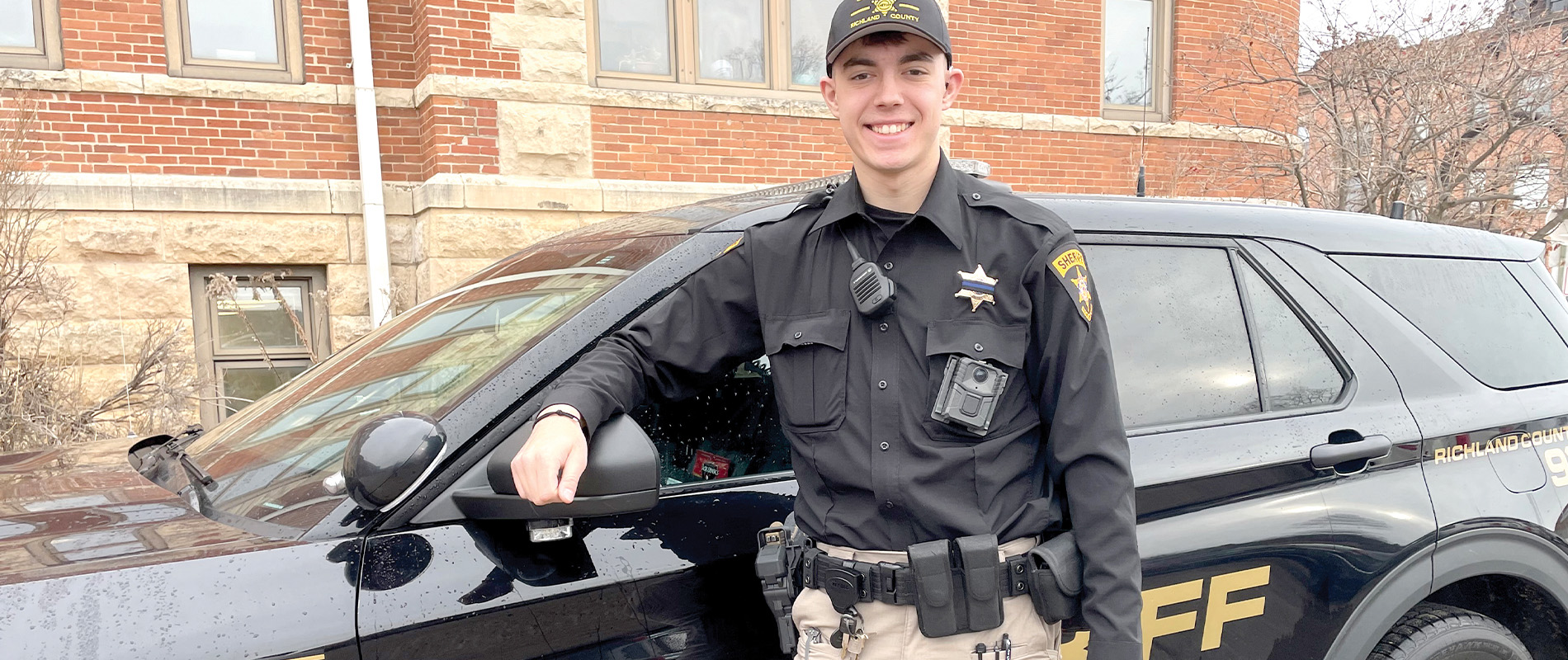
The Criminal Justice Law Enforcement 2 program is designed specifically for aspiring law enforcement officers. Coursework integrates academic theory with practical application relevant to patrol operations, investigations, supervision, and community engagement. The program promotes critical thinking and problem-solving through case studies, scenario-based learning, and analysis of real-world incidents.
Through scenario-based learning, case studies, and experiential opportunities, students gain practical insight into criminal investigations, report writing, evidence handling, and courtroom processes. Graduates are prepared for entry-level positions in law enforcement, corrections, private security, and related fields, or for transfer to four-year institutions to pursue advanced degrees.
This program includes an embedded Wisconsin Law Enforcement Academy which will allow graduates to pursue entry-level law enforcement positions. The law enforcement academy has several additional entrance requirements. Interested students are encouraged to speak with a program advisor to learn more.
- Overview
-
Is This Program for You?
If you are interested in making a difference in your community by providing safety, order and serving those in need, a career in law enforcement may be for you.
Students entering the Criminal Justice Law Enforcement 2 program should have the following skills and abilities:
- The ability to work professionally and respectfully with diverse populations.
- Strong written and oral communication skills
- Analytical thinking and problem solving skills
- Strong internal motivation and the ability to work independently
- Strong attention to detail with the ability to rapidly perceive and process information
- The ability to work in various work conditions, including inclement weather, holidays, nights and weekends
- Have a strong moral and ethical background that promotes public service
- Possess the necessary physical, medical, emotional and psychological conditions necessary to meet the requirements of the profession
- The ability to respond to emergency situations in a calm, focused and safe manner
- Remain objective and non-biased in interactions with the public
- Possess driving records and criminal history backgrounds that free of disqualifying offenses
Program Basics
- Associate degree, requiring a minimum of two years to complete.
- The majority of classes are offered face to face on campus. Some training sessions will be hosted during the evening and outdoors.
- Fall start.
- Financial aid available.
- Credit for prior learning may be available.
- Curriculum & Costs
-
Cost of Attendance (COA) 26-27
Cost of Attendance (COA) is a total of all the usual expenses of being a student. The COA sets the maximum amount of financial aid a student can receive.
Category Amount Tuition and Fees $5,240 Living Expenses (Housing and Food) $10,910 Books and Supplies $1,463 Personal Expenses $3,084 Transportation 3,899 Charger Tech 360 Fee $700 Loan Fees $85 Yearly Total (Living Away from Home) $25,381 1 Semester Total (Living Away from Home) $12,691 Based on Wisconsin Residents.
Approximate school costs are for a full-time (12 credit) student over a semester span of 17 weeks.
Fees are legislated by the Wisconsin Technical College System Board.
These costs are estimates and are subject to change without notice.
- Admissions & Requirements
-
Admission Requirements
Academic Preparedness Requirements
- Before you can be fully accepted into your program, you need to complete the requirements below. These are the same requirements you may see in your SWTC Student Portal.
- Submit Official High School, College, Military Transcripts, and Test Scores (Not Required)
Have documents sent directly to:- Email: admissions@swtc.edu
- Mail: Southwest Wisconsin Technical College, Attn: Admissions, 1800 Bronson Blvd, Fennimore, WI 53809
- Meet with Your Advisor for an Admissions Meeting
Schedule an admission meeting with your program advisor to complete your student success plan, including a career assessment and academic map and support plan.
To schedule your meeting, go to the Appointments page. Find your advisor in the list, then select Make an Appointment under their contact information.
Appointments are available on campus or virtually.
If you want to check which of these requirements you still need to complete, log in to your SWTC Student Portal, go to My Profile → Document Center, and make sure All Programs is selected.
- Submit Official High School, College, Military Transcripts, and Test Scores (Not Required)
- Outcomes
-
Program Outcomes
At the completion of the program, students are expected to be able to:
- Recognize the personal demands required of police.
- Demonstrate proper police investigative procedures.
- Demonstrate effective communication with diverse populations.
- Understand legal principles and procedures to ensure justice.
- Apply Wisconsin statutes when analyzing criminal behavior.
- Demonstrate writing skills.
- Practice good personal fitness strategies.
- Practice effective team member attributes.
- Career Opportunities
-
The profession of law enforcement, also known as police science, is becoming very people-oriented. Law enforcement officers spend a great deal of time communicating and interacting with an increasingly diverse population. Officers are more active in community relations and crime prevention, and they must always be able to react immediately to any level of emergency. Criminal Justice—Law Enforcement 2 prepares graduates for careers as:
- Police officers
- Deputy sheriffs
- Security guards
- Bailiffs
- Correctional officers
Each of these careers may require special additional requirements and/or training.
Southwest Tech's Career Services Center offers services to assist students looking for job placement.
Find a Job - Transfers
- Prior Learning
-
Credit for Prior Learning
Experience Pays! You've Been There... You've Done That... Let's See If You Can Get Credit For It!
Credit for prior learning gives you opportunities to earn credit for college-level knowledge that you have already acquired. This may be the result of work or volunteer experiences, certifications, apprenticeships, military training, extensive self-instruction, or professional development. Credit for Prior Learning affords you the opportunity to accelerate the completion of your educational goals.
For more information on Credit for Prior Learning see our Credit for Prior Learning page.
Criminal Justice - Law Enforcement 2 Courses that may have Credit for Prior Learning options:
Course # Course Title Challenge Exam
(Demonstration)Challenge Exam
(Standard)CLEPCredentialPortfolio10-801-136 
CLEP Test - College Composition 10-801-198 10-809-196 10-809-198 CLEP Test - Introduction to Psychology